
Overview
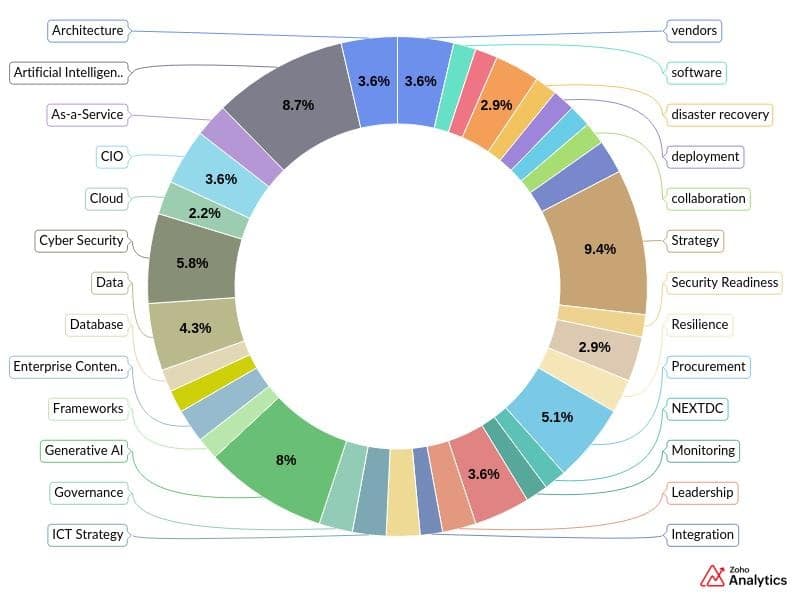
The past month’s inquiries highlight a resurgence in focus on artificial intelligence, which executive concerns, with numerous inquiries surrounding its strategic integration, governance, risk mitigation, and data management. Risk and operational continuity remain a major concern, though recent cloud outages have raised specific concerns about hybrid and multicloud disaster recovery. This suggests that senior ICT executives are grappling with the delicate balance between technological advancement and sustainable, secure operations, underscoring the need for pragmatic implementation frameworks and informed decision-making.
Hottest Topics
Inquiries
Solve
Implementing Resilient Disaster Recovery with Azure
A public sector organisation sought to establish a geographically diverse disaster recovery capability outside their state, moving from a dual-data-centre model to a three-site architecture. IBRS outlined a day one minimum viable product (MVP) pilot, detailing configurations for workloads, storage, and secure VPNs. The advice also covered a post-MVP scale-out strategy using the ‘7 Rs’ framework for application migration, ensuring continuous service continuity and reduced concentration risk.
Request support from Andrew Fox on creating cloud resilience.
Modernising Disaster Recovery Planning for Local Government
A local government client needed to develop a new disaster recovery plan, moving from an outdated system to a hybrid model that uses NextDC colocation and on-site warm disaster recovery infrastructure. IBRS provided a comprehensive framework aligned with NIST SP 800-34, advising on policy, business impact analysis, the 3-2-1 rule for data, immutability, automated verification, and a tiered testing programme, ensuring operational resilience and clear responsibilities.
Request assistance in developing a more robust disaster recovery strategy.
Plan
Strategic Sourcing for Marketing Technology
A media and entertainment organisation sought to deepen its understanding of data-driven marketing technology brands such as Adobe, AI companies, and Databricks for potential co-sponsorship deals. IBRS delivered a detailed analysis, building vendor profiles and grouping them into ‘sponsorship personas’ to identify strong matches. This included targeting ‘global Cloud & AI infrastructure titans’ and ‘mass-market consumer tech platforms’, enabling a strategic approach to future partnerships.
Request a market scan of emerging digital marketing technologies.
Digital Readiness Audit for Not-for-Profit Transformation
A not-for-profit organisation conducting an internal audit for a large-scale digital transformation needed advisory support on audit scope, procedures, key risks, and common pitfalls. IBRS provided guidance on readiness for service processes, including go-live checklists, rollback plans, vendor management, Hypercare, and change freezes. This support aimed to help the client independently assess control adequacy and management’s readiness processes.
Perform a digital readiness assessment with IBRS
Explore
Governing AI-Assisted Development and Self-Hosted AI for Government
A public sector organisation was exploring AI-assisted code development and self-hosting AI for document summarisation and voice-to-text, seeking advice on mitigating security risks and licence costs. IBRS detailed critical gaps in existing controls, provided a pragmatic AI coding governance framework, and assessed the viability of self-hosted open-source AI models (Whisper, Llama 3) for specific functions, balancing cost-effectiveness with operational overhead.
How can we develop a highly secure AI infrastructure on our own infrastructure?
Strategic Planning for AI Adoption in Local Government
A local government client needed to draft an AI strategy and sought IBRS’s insights into current industry approaches. IBRS provided an extensive 33-page template for a local government AI strategy, drawing on global best practices. This resource offers a structured approach to developing comprehensive AI strategies, ensuring the client can effectively incorporate key sections and subsections tailored to their specific needs and context.
Request a copy of the AI Strategy template
Document Reviews
- Internal Audit of Technology Risk Registry
- Preliminary Review of DR and Firewall Architecture
Whiteboard Sessions
- Agency Digital Resilience Discussion: Focused on enhancing security posture for a key agency, addressing audit findings, and identifying future improvements.
- Strategic IT Evolution Review: Clarified future IT architecture, incorporating lessons from DR testing and a cyber security audit.
- Geographically Distributed Capability and Future-Proofing Strategy Session: The client received validation of their approach, clarification of directions, and actionable next steps for their disaster recovery strategy.
- Domain Transition Planning – Client Outcomes: Outlined key actions for a smooth domain name change, ensuring a clear path forward for the client.
- Strategic ICT Alignment Workshop: Insights into future business drivers and how ICT strategy can support executive goals.
- Strategic IT Planning Review: Solidified future IT capacity and resourcing to meet evolving business needs.
- Project Delivery Efficiency Whiteboard Session – Vendor Selection: Reviewed three vendor responses, leading to recommendations on the optimal solution.
- Strategic Market Review Concluded: Comprehensive strategy presentation that informed their go-to-market approach and RFI stage.
- Strategic Oversight and Risk Mitigation Workshop: Developed risk register, streamlined approvals, and enhanced security for organisational change.
- Digital Transformation Strategy Workshop: Clarity on risk mitigation and cost-effective security options, defining next steps.
- Maximising Value from Organisational Software Investment: Developed strategies to optimise Microsoft licensing, address wastage, and effectively manage their LSP, improving multi-million-dollar annual expenditure.
- SIAM Strategy Alignment Whiteboard: Reviewed complex multi-vendor resource alignment, clarifying commercial arrangements and stakeholder roles for improved understanding.
- Organisational Strategy Session: Frameworks, templates, timelines, and processes were outlined, providing clients with a clear go-to-market strategy.